Global Sea Surface Temperature Variability Observed by the AMSR Series
(Data updated for September 2026)
The AMSR series observations, which began in 2002, has continuously monitored variations in Earth's water cycle for more than 20 years, despite an observational gap of approximately nine months between AMSR-E and AMSR2. With the launch of the latest instrument, AMSR3, in June 2025, this observation record will be further extended, aiming to achieve the 30-year data accumulation required for the generation of climate normals (Note 1). Toward an era in which the AMSR series serves as a benchmark for climate change detection, this page presents monthly updates of global sea surface temperature (SST) variability analyzed exclusively using AMSR series observations (Note 2).
September 2026: Record High September Temperature in the AMSR Time Series
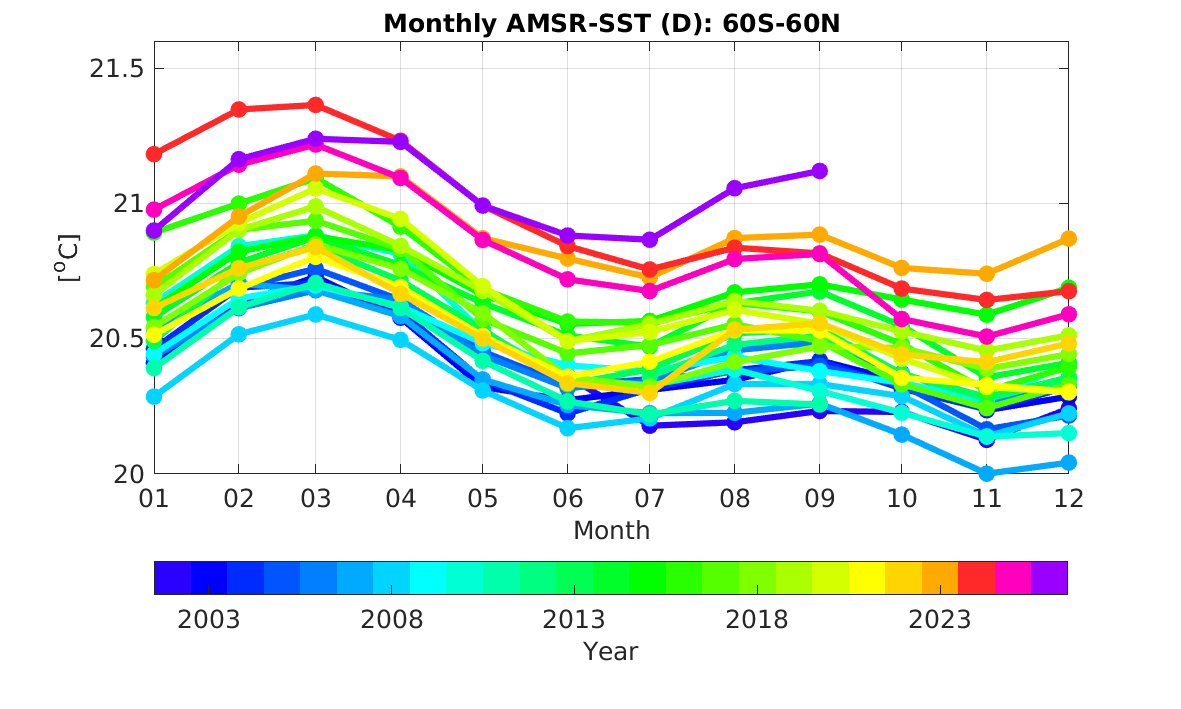
Figure 1 Seasonal variation of monthly mean global SST (60°S-60°N) (Note 3)
Observing satellites: Aqua/AMSR-E (June 2002 - September 2011)
GCOM-W "SHIZUKU" / AMSR2 (July 2012 - present)
(No observations were available from October 2011 to June 2012.)
Notes:
Note 1: Climate Normal
A climate normal is a reference value created using data from a fixed period in the past (defined by the World Meteorological Organization as 30 years) and is used to assess whether current conditions are typical or anomalous.
As the AMSR series has not yet achieved a full 30-year record, values calculated using a total of 20 years of data—October 2002 to September 2011 (AMSR-E) and October 2012 to September 2023 (AMSR2)—are used as the “normal value” presented on this page (see here for details of the calculation method).
Note 2: Data Characteristics and Missing Data
Satellite observations offer the advantage of covering wide areas within a short time; however, data gaps may occur depending on observation conditions. Such gaps can affect the appropriate extraction of trends and periodicity in observed phenomena. Therefore, depending on the application, gap-free objective analysis datasets—created by statistically interpolating and integrating multiple satellite and in-situ observations—are widely used.
The AMSR series has one of the world's highest observation capabilities, enabled by its orbital design, low-frequency channels capable of observing the surface through clouds, and its large antenna, allowing high-resolution observation of most of the globe within approximately two days. Nevertheless, on timescales of several days, partial data gaps may still occur due to weather conditions or radio-frequency interference.
The data presented on this page are derived from monthly averages, during which sufficient data are accumulated for each region, without interpolating missing areas. As a result, the outcomes may not always be consistent with those obtained from objective analysis datasets.
In addition, SSTs derived from AMSR observations represent conditions at a depth of only a few millimeters below the surface and are therefore sensitive to solar heating, wind, and precipitation. In contrast, many objective analysis datasets attempt to remove such effects, which can lead to differences between the two. To minimize the influence of solar radiation, only nighttime (descending orbit) AMSR observations are used here.
Note 3: Data Consistency
The AMSR series Level-3 SST products may exhibit quality differences between versions due to updates. To ensure data consistency, the analyses shown on this page use data extracted with consistent quality by applying quality flags from the Level-2 products.