ALOS-4
Observation Plan
PALSAR-3 Observation Plan
There are maps/kml of basic and thematic observation plans for each cycle.
Observation simulation results will be uploaded 4 times per year.
Basic Observation Scenario (BOS)
The following tables show the sensor (observation) modes designated for each cycle based on the Basic Observation Scenario for ascending and descending paths, respectively (World/ Japan).
- PALSAR-3 Basic Observation Mode per cycle (World)
- PALSAR-3 Basic Observation Mode per cycle (Japan)
- PALSAR-3 Thematic Observation Map
Please check the PALSAR-3 observation maps by thema here.
PALSAR-3 PRF Fixed Observation Mode Blind Map
Blind areas occurring within images captured in PALSAR-3PRF fixed observation mode are published as blind maps in KML format.
*We corrected the issue where the KML file for Pattern 2 was stored in UWD02 of PRF Fixed Pattern 1 (January 29, 2026).*We corrected the issue where kml file of UWD was stored in UWD02R of PRF Fixed Pattern 1 (February 9, 2026).
*We have released additional blind maps for the PRF fixed observation mode XBD01, XBD03 (February 20, 2026).
*We corrected the issue where the World KML files were missing in the equatorial region (July 23, 2026).
| Area | Obs. Mode |
Beam No. | Resolution /swath |
Zone No. | Azimuth | Observing Direction |
Download / KML unit | |||
|---|---|---|---|---|---|---|---|---|---|---|
| PRF Fixed Pattern1 | PRF Fixed Pattern2 | |||||||||
| Japan | UWD | 01-03 | 3m/200km | ZONE2 | Des./Asc. | R/L | Path(2.7MB) | Area(2.7MB) | Path(2.3MB) | Area(2.3MB) |
| UBD | 01-05 | 3m/100km | Path(2.2MB) | Area(2.0MB) | Path(2.0MB) | Area(1.9MB) | ||||
| 15-23 | Path(3.9MB) | Area(3.6MB) | Path(4.2MB) | Area(4.0MB) | ||||||
| World | UWD | 01 | 3m/200km | ZONE1-5 | Des./Asc. | R | Path(150MB) | - | Path(141MB) | - |
| HBQ | 06 | 6m/100km | Path(78.0MB) | - | Path(83.4MB) | - | ||||
| 08 | Path(82.5MB) | - | Path(85.1MB) | - | ||||||
| FWD | 01 | 10m/200km | Path(102MB) | - | Path(111MB) | - | ||||
| 02 | Path(129MB) | - | Path(131MB) | - | ||||||
| 03 | Path(145MB) | - | Path(134MB) | - | ||||||
| XBD | 01 | 25m/700km | Path(241MB) | - | Path(262MB) | - | ||||
| 02 | Path(252MB) | - | Path(276MB) | - | ||||||
| 03 | Path(302MB) | - | Path(329MB) | - | ||||||
* Path: KML files split by satellite orbit number (path number)
* Area: KML files containing all observation paths within Japan
【Important Notes】
- Please note that the blind map is based on nominal values and therefore does not perfectly match the areas of actual observation data.
- The fixed PRI settings for observation data are documented in AUIG4.
Please verify the fixed PRI settings for the scene ID of interest in AUIG4 and then refer to the corresponding KML file.
Fixed PRI settings are determined by the zone band of the scene ID (see figure below). - For information on the PRI setting pattern (1 or 2) for each observation cycle, please refer to this link (Japan/World).
- Please set the coordinate reference system to the geographic coordinate system (latitude, longitude).
【Directory structure】
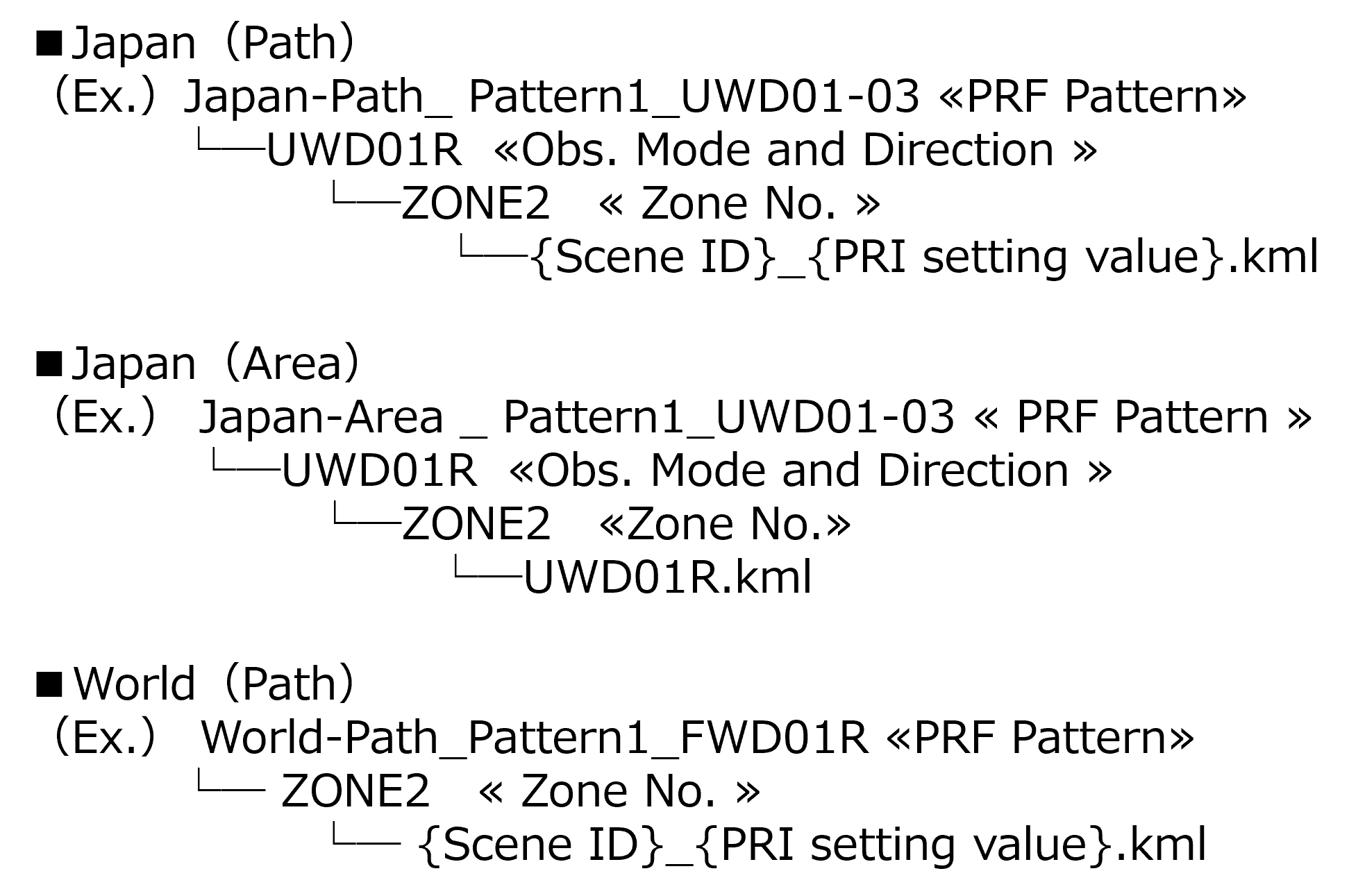

Fig. Blind Map Zone Classification

Fig. Example of PALSAR-3 (UWD01 Mode) Blind Map
(Left:PRF Fixed Pattrrm1、Right:PRF Fixed Pattrrm2,
Legend :□ the sub beam range, □ Blind area)
Shapefile of observation path/frame
Observation area of PALSAR-3 path/frame for each observation mode used in the BOS can be downloaded in Shapefile format.
 UWD01R_A
 XBD02R_A
 FWD01R_A
| Sensor mode | Sensor Code [Beam No] | Polarization | Off-nadir angle | Pass designation | Beam direction |
|---|---|---|---|---|---|
| Stripmap10m 200km swath. | FWD [FWD01-FWD03] |
HH+HV | 3 Beam 28.2°- 44.3°, 41.9°- 48.2° |
Both (Ascending, Descending) |
Right |
| Stripmap6m 100km swath. | HBQ [HBQ06, HBQ08] |
HH+HV+VH+VV | 2 Beam 29.1°- 32.4°, 35.5°- 38.2° |
Both (Ascending, Descending) |
Right |
| Stripmap3m 200km swath. | UWD [UWD01-UWD03] |
HH+HV | 3 Beam 29.1°- 48.0° |
Both (Ascending, Descending) |
Right/Left |
| ScanSAR 700km swath. | XBD [XBD02] |
HH+HV | 4 Scan 39.1° |
Both (Ascending, Descending) |
Right/Left |